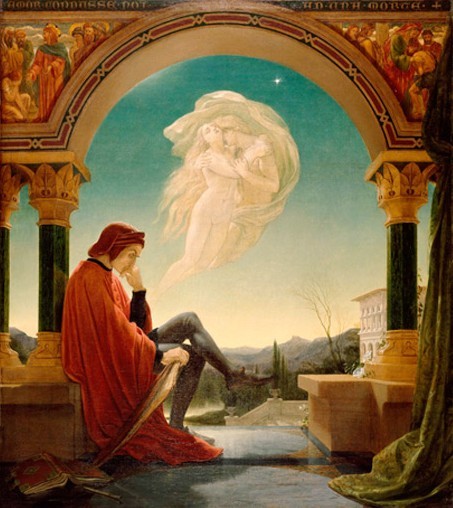

(Above) Modern ART by Scott Burdick. http://www.scottburdick.com/
I'm a great admirer of the classical/romantic realist tradition, and an admirer of the great artists of the pasts, such as the Waterhouse, Burne-Jones, the two Leightons, Bougureau and Gerome. This is what I aspire to in my fine art, and though I hopefully edged slightly closer to it in paintings like 'The Lady of Shalott' and 'Tell Me More or Tell me Less', I'm under no illusions of being on that level yet. The frustration is that in the current art world, there is no incentive to pursue this ambition. Still I try, and by doing so gain a greater appreciation of the dedication, discipline, patience and skill that went into paintings such as those I was admiring in Oxford yesterday. I should do some more traditional painting, but I've been kept so busy lately with digital illustration commissions, not that I'm complaining.
I've just been pointed to Scott Burdick's discussion in a set of youtube vids, contrasting this tradition to what prevails in the Modern Art establishment.
He's preaching to the totally converted as far as I'm concerned. There are living artists every bit as skilled as the artists of the Renaissance and 19th century, as able to evoke elegance, beauty, emotion, grandeur, poignancy and deep humanity with masterful technical skill.
In many galleries, traditional art is represented up to a certain time (around the turn of the 20th century) and then disappears with only the modernist avant garde movements being represented. This, as Brudick argues, leads to the false impression that no one (with the possible exception of certain Surrealists) retained the ability or desire to produce technically compitent and aesthetically beautiful paintings.
The criteria of what makes art are held as valid up to an arbitrary point when experimental alternative ideas came along. This is well and good but we are led to take for granted that the experiment of modernism was valid in every respect, and that it was legitimate to rewrite the definition of art, which had essentially held good since the renaissance. Therefore none of the founders of the English Royal Academy for instance, would be considered serious artist by the present art establishment. Conversely, I doubt the founders of the RA, or subsequent members like Millais, Leighton and Waterhouse, would recognize the present members as their true artistic heirs. Contemporary traditional painting is only really well represented at somewhere like the National Portrait Gallery, presumably because abstract and conceptual artists don't excell at portraiture, for the most part.
Duchamp was significant in so far as he inspired a certain manifestation of existential philosophy that uses visual props and calls itself art. The thing is that nothing new has been said in conceptualism since Duchamp but conceptualists still rather dominate the art scene. This is a bit odd when you think about it. There are still people painting like impressionists and preraphaelites, or whatever, who are dismissed as obsolete and unoriginal and historically irrelevant by these same conceptualists who are themselves only churning out variations on a now-antiquated theme. So what it really boils down to is the establishment preferring a style than to any real progressiveness, and pretending that it is philosophically superior to classical painting. Part of the false premise is that beauty equates to cheapness or triviality, whereas in fact beauty is rare enough, hard won, and can be profound in its own right.